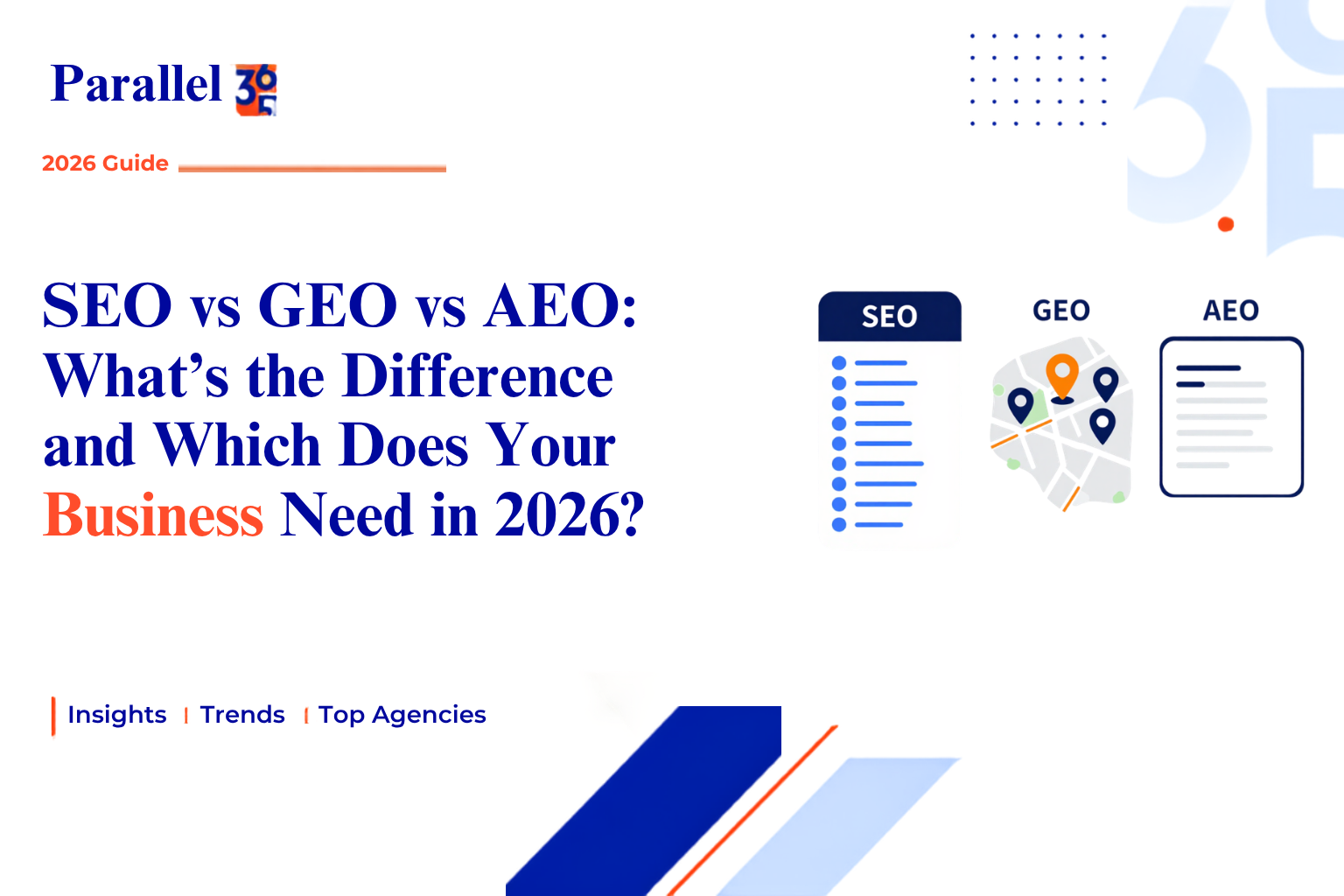
A few years ago, “search visibility” meant one thing: where you ranked on a Google results page. That’s no longer the whole picture. Today, a customer might find your business through a traditional blue-link search result, through a Google AI Overview that summarizes the answer before any links even appear, or through a direct question typed into ChatGPT, Perplexity, or Gemini that never touches a search engine at all. Three different discovery paths, three different sets of rules — and three acronyms that get used interchangeably even though they aren’t the same discipline.
That confusion is costing businesses visibility. Teams that optimize only for classic SEO are often invisible inside AI-generated answers, even when they rank well in traditional results. Teams that chase “AI visibility” without a real SEO foundation are usually building on sand. Understanding what SEO, GEO, and AEO actually mean — and how they work together rather than as competing strategies — is one of the most important marketing decisions a business can make heading into 2026.
What Is SEO (Search Engine Optimization)?
SEO is the discipline of making a website more visible in traditional search engine results — primarily Google, but also Bing and others. It covers technical site health, keyword targeting, content quality, backlinks, and local search signals like Google Business Profile optimization. SEO has been the foundation of digital visibility for two decades, and it still drives the largest share of organic traffic for most businesses.
What’s changed is the destination. SEO used to mean earning a top-ten blue link. Increasingly, it means earning the content that AI systems pull from when they generate an answer — which is why strong SEO has become a prerequisite for the next two disciplines, not a separate track.
What Is GEO (Generative Engine Optimization)?
GEO is the practice of optimizing content so it gets cited, summarized, or referenced by generative AI systems — Google AI Overviews, ChatGPT, Perplexity, Gemini, and similar tools. Instead of optimizing purely for ranking position, GEO focuses on structure, clarity, and authority signals that make content easy for a language model to extract, trust, and quote.
This matters because the customer journey has changed. A growing share of research now happens inside a single AI conversation, where the model picks a handful of sources to cite and ignores the rest. If your content isn’t structured in a way that a generative engine can confidently use, you may be technically “findable” but functionally invisible at the exact moment a prospect is deciding who to call.
What Is AEO (Answer Engine Optimization)?
AEO is closely related to GEO but slightly narrower: it’s the practice of structuring content to directly and clearly answer specific questions, so it gets pulled into featured snippets, voice search results, and the direct-answer boxes that sit above traditional search results. AEO leans heavily on clear question-and-answer formatting, schema markup, and concise, definitive answers near the top of a page — exactly the kind of structure this article uses.
In practice, GEO and AEO overlap heavily, and many agencies now use the terms together. The distinction worth remembering is that AEO is about answering a specific question precisely, while GEO is about being the source a generative model trusts enough to summarize or cite across a broader range of related queries.
SEO vs GEO vs AEO: How They Actually Compare
| SEO | AEO | GEO | |
|---|---|---|---|
| Primary goal | Rank in traditional search results | Get pulled into direct-answer boxes and snippets | Get cited or summarized by AI/generative engines |
| Core unit of success | Ranking position, organic traffic | Featured snippet or voice answer placement | Citation or mention inside an AI-generated response |
| What it depends on | Technical SEO, keywords, backlinks, content depth | Clear, structured Q&A formatting, schema | Authority, clarity, structure, and trustworthy sourcing |
| Where it shows up | Google, Bing search results pages | Featured snippets, voice assistants | ChatGPT, Perplexity, Gemini, Google AI Overviews |
| Still depends on | — | Strong underlying SEO | Strong underlying SEO and AEO |
The important takeaway from that table isn’t that these are three competing strategies to choose between. It’s that they’re layered. GEO and AEO don’t replace SEO — they’re built on top of it. A business with no SEO foundation has very little chance of being cited by an AI engine, because generative models still favor sources that already carry search authority and structural clarity.
Which Does Your Business Need First?
For most businesses, the honest answer is: all three, sequenced correctly. Here’s a simple way to think about prioritization:
If your website has thin content, technical issues, or weak local visibility — start with SEO fundamentals. AEO and GEO won’t help if there’s no underlying authority for an AI engine to draw from.
If your industry involves a lot of direct, comparison-style questions (“best agency for X,” “how does Y work,” “X vs Y”) — AEO-focused content structure should be a near-term priority, since these are exactly the query types AI answer boxes favor.
If your buyers increasingly research using AI tools before contacting a business — which is now true across professional services, B2B, healthcare, and most high-consideration purchases — GEO needs to be part of the strategy now, not in a future phase.
This is precisely why treating SEO, AEO, and GEO as separate vendor relationships tends to create gaps. Parallel 365 builds these together under its Performance Growth & Lead Generation service line, which includes Full-Funnel SEO & AI Search Visibility as a single, integrated workstream rather than three disconnected projects. The same content strategy, technical foundation, and authority-building work feeds traditional rankings, answer boxes, and AI citations simultaneously — which is how the discipline should function in 2026, since the underlying signals overlap so heavily.
This integrated approach matters most for service-based businesses, where buyers research extensively — often through AI tools — before ever filling out a contact form. If your prospects are asking ChatGPT “who’s the best [your category] in [your city]” and your business isn’t part of that answer, a fragmented, single-channel approach to search won’t fix it.
If you’re trying to determine where your business currently stands across all three areas, Parallel 365’s free Brand Health Check is a useful starting point — it evaluates traditional search visibility alongside AI search presence, rather than treating them as separate audits.
For businesses specifically researching specialized GEO partners in Texas, our breakdown of the top GEO companies in Texas covers agencies focused exclusively on generative engine visibility. And if foundational SEO and lead generation are the more immediate priority, our guide to the top SEO firms for lead generation in Texas is a good next read.
How to Choose Between SEO, AEO, and GEO Providers
Does the agency treat these as one strategy or three separate retainers? If GEO is sold as a bolt-on add-on disconnected from your core SEO work, you’ll likely end up with inconsistent messaging and duplicated effort across teams.
Can they show you what’s actually happening inside AI answers today? A capable partner should be able to show you, concretely, whether your business currently appears (or doesn’t) when relevant questions are asked inside ChatGPT, Perplexity, or Google AI Overviews — not just promise future results.
Do they understand schema markup and content structure, not just keywords? AEO and GEO success depends heavily on technical formatting — structured data, clear headings, direct answers — that a keyword-only SEO approach often misses entirely.
Is trust and authority part of the strategy, or just rankings? Generative engines weigh source credibility heavily. An agency that only chases keyword rankings, without building genuine topical authority, will struggle to earn AI citations even if traditional rankings improve.
For businesses weighing whether they need a specialist in one of these disciplines versus a single partner who handles all three, our guide on full-service vs. specialized agencies walks through that decision in more detail. For financial services and other high-trust industries where AI-generated answers carry particular weight, our guide to marketing agencies for financial services firms in Texas covers how trust and authority signals factor into search visibility for regulated industries specifically.
Frequently Asked Questions
Is GEO replacing SEO?
No. GEO depends on strong SEO fundamentals — technical health, content authority, and backlinks — to work at all. Think of GEO as an extension of SEO for a new set of destinations (AI engines), not a replacement for the discipline.
Do I need to do AEO and GEO separately, or can one strategy cover both?
In most cases, one integrated content and technical strategy can address both, since the underlying requirements (clear structure, direct answers, schema markup, authority) overlap significantly. Separate vendor relationships for each tend to create more coordination overhead than value.
How do I know if my business is showing up in AI search results?
The most direct way is to test relevant queries yourself across ChatGPT, Perplexity, Gemini, and Google AI Overviews and see whether your business is mentioned. Many agencies, including Parallel 365, now build this kind of AI visibility check into broader brand audits.
Is GEO/AEO only relevant for large companies?
No — if anything, GEO and AEO create an opportunity for smaller, well-structured businesses to be cited in AI answers ahead of larger competitors who haven’t adapted their content structure yet. Authority and clarity matter more than company size.
How long does it take to see results from GEO and AEO efforts?
Results vary, but because GEO and AEO depend on the same authority signals as SEO, timelines are similar — meaningful movement typically takes a few months of consistent, structured content and technical work, though some AI citation gains can appear faster than traditional ranking improvements.
See Where Your Business Stands Across Search, Answer Engines, and AI
Search visibility in 2026 isn’t a single scoreboard anymore. Parallel 365’s free Brand Health Check shows you where your business currently stands across traditional search, answer engines, and generative AI — so you know exactly where to focus first. You can also schedule a strategy review to talk through your specific goals.