Every marketing agency claims to deliver results. A performance marketing agency is built specifically around the idea that results should be measurable, trackable, and directly tied to what you’re paying. If a tactic doesn’t move a number you care about, it gets cut, regardless of how creative or clever it looked on paper.
This guide covers what a performance marketing agency actually does, what performance marketing services typically cost in 2026, and how to separate a genuinely results-driven agency from one that just uses the term as a sales pitch.
What Is a Performance Marketing Agency?
A performance marketing agency is a firm that manages paid and measurable marketing channels with a direct focus on trackable outcomes, such as leads, sales, app installs, or a specific return on ad spend target, rather than broader brand or awareness goals. The defining trait is measurability: every dollar spent should be traceable to a result, and campaigns are adjusted continuously based on that data rather than run out to completion regardless of performance.
This distinguishes it from traditional advertising or brand agencies, where success might be judged on reach, impressions, or creative quality without a direct line to revenue.
What Performance Marketing Services Typically Include
A digital performance marketing agency usually manages some combination of the following:
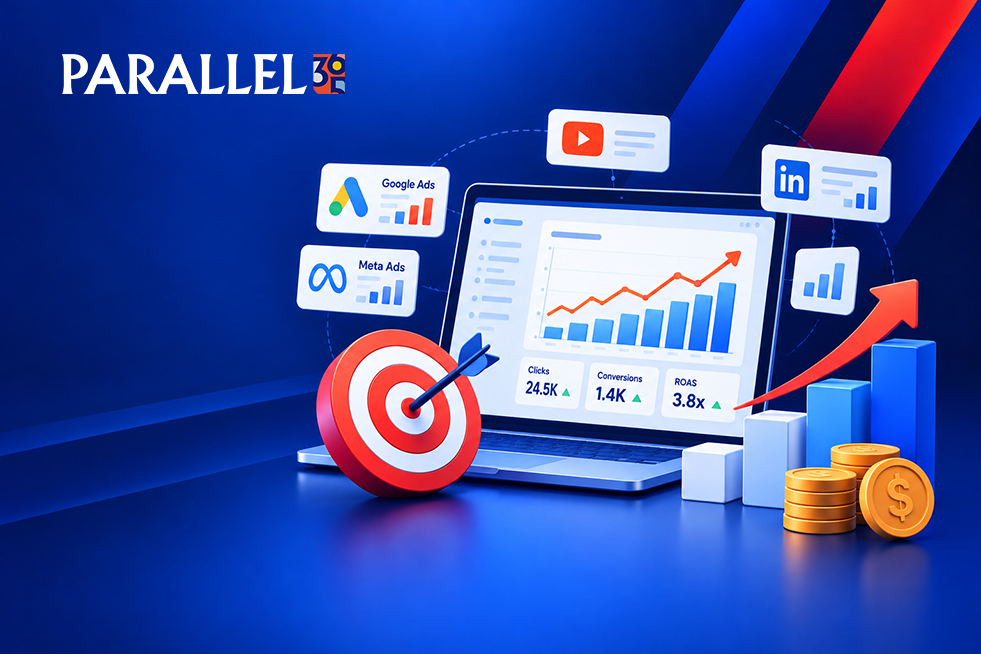
Paid search advertising. Google Ads and Microsoft Ads management, including keyword strategy, bid management, and landing page alignment.
Paid social advertising. Meta, TikTok, LinkedIn, and Pinterest campaign management, covering audience targeting, creative testing, and budget optimization.
Programmatic and display advertising. Automated ad buying across ad networks and exchanges, often used for retargeting and broader reach at efficient costs.
Conversion tracking and analytics setup. Building out the tracking infrastructure (pixels, meaning small tracking codes placed on your website; conversion events; and attribution models, the system that decides which ad or channel gets credit for a sale) needed to actually measure what’s working, since performance marketing is only as good as the data behind it.
Landing page and funnel optimization. Testing and refining the pages traffic lands on, since even well-targeted ads underperform if the destination page doesn’t convert.
Creative production and testing. Producing and iterating on ad creative, since creative fatigue is one of the biggest drivers of rising costs in paid channels over time.
Reporting tied to business outcomes. Regular reporting focused on cost per acquisition, return on ad spend, and revenue impact rather than surface metrics like impressions or click-through rate alone.
Performance Marketing Agency Cost in 2026
Performance marketing agency cost typically falls between $2,000 and $12,000 a month in management fees, not including ad spend itself, though enterprise programs with complex multi-channel scopes can run well beyond that.
| Business Size / Ad Spend | Typical Monthly Management Fee |
| Small local business ($1,000 to $5,000 ad spend) | $500 to $1,500 |
| Growing SMB ($5,000 to $25,000 ad spend) | $1,500 to $4,000 |
| Mid-market ($25,000 to $100,000 ad spend) | $4,000 to $10,000 |
| Enterprise ($100,000+ ad spend) | $10,000 to $30,000+ |
These figures cover the agency’s management fee only. Ad spend is a separate, and usually much larger, line item that goes directly to the ad platforms rather than the agency.
The Pricing Models Performance Marketing Agencies Use
Percentage of ad spend. The most common model, typically 10 to 20 percent of monthly media budget. The percentage often decreases at higher spend tiers, since a smaller percentage of a large budget still generates a substantial fee. The downside is a potential conflict of interest: the agency earns more as your spend grows, whether or not increasing spend is actually the best decision.
Flat monthly retainer. A fixed management fee regardless of ad spend fluctuations. This removes the incentive misalignment of the percentage model and tends to be more predictable for budgeting, which is why many buyers now prefer it.
Performance-based or hybrid. A base fee combined with bonuses tied to hitting specific targets, such as a cost-per-acquisition threshold or a return on ad spend goal. Pure performance models, where the agency is paid only when results are delivered, exist but are less common outside of certain niches like affiliate and lead generation marketing.
Project-based. Used for defined, one-time engagements such as an account audit, a full campaign rebuild, or a tracking infrastructure setup. These typically run $1,500 to $25,000 depending on scope and how many channels are involved.
Flat Fee vs. Percentage of Spend: Why It Matters at Scale
The pricing model matters more as ad spend grows. At $50,000 a month in spend, a 15 percent management fee comes out to $7,500, while a flat-fee agency at a comparable service level might charge closer to $3,000 to $4,000 for the same work. Over a year, that gap can add up to tens of thousands of dollars, which is why larger advertisers increasingly negotiate flat or tiered flat fees instead of a straight percentage once spend passes a certain threshold.
How to Choose the Best Performance Marketing Agency
Ask what “performance” actually means in their reporting.
Some agencies define performance as impressions and click-through rate. The best performance based marketing agencies define it as cost per acquisition, return on ad spend, and revenue, and can show you exactly how those numbers moved for past clients.
Check whether pricing incentives are aligned with your goals.
If an agency is paid a percentage of ad spend, ask directly how they decide when to recommend spending more versus optimizing existing spend more efficiently.
Look at account structure and staffing.
Ask who will actually manage your account day to day, not just who’s on the sales call, and how many other accounts that person handles.
Request a sample of their actual reporting.
A real performance marketing agency should be comfortable showing you what a monthly report looks like before you sign anything, not just describing it in general terms.
Confirm the minimum ad spend needed to see results.
Below a certain spend threshold, most channels simply can’t generate enough data to optimize effectively. A good agency will tell you honestly if your budget is too small for the channel mix you’re considering, rather than taking the engagement anyway.
Signs You’re Overpaying for Performance Marketing
If your agency can’t clearly explain what specific actions produced a given result, if reporting focuses mainly on vanity metrics (like impressions or follower counts) rather than cost per acquisition or return on ad spend, or if a straightforward comparison shows a flat-fee competitor charging significantly less for a comparable scope, those are all signs worth investigating. Performance marketing is one of the more measurable categories of marketing spend. If an agency can’t or won’t show you the numbers behind their fee, that itself is worth questioning.
Frequently Asked Questions
What is a performance marketing agency?
A performance marketing agency manages paid and measurable marketing channels, such as search and social advertising, with campaigns optimized continuously against trackable outcomes like leads, sales, or return on ad spend.
How much does a performance marketing agency cost?
Performance marketing agency cost typically runs $2,000 to $12,000 a month in management fees for small and mid-sized businesses, separate from ad spend, with enterprise programs running higher.
What’s the difference between percentage of spend and flat fee pricing?
Percentage of spend charges a fee based on your ad budget, usually 10 to 20 percent, while a flat fee stays constant regardless of spend. Flat fees tend to be more cost-effective and better aligned with your interests at higher spend levels.
What services does a performance marketing agency provide?
Most performance marketing services include paid search, paid social, programmatic advertising, conversion tracking setup, landing page optimization, creative production, and reporting tied to acquisition cost and revenue.
How do I find the best performance marketing agency for my business?
Look for an agency whose reporting is tied to acquisition cost and revenue rather than impressions, whose pricing model doesn’t create a conflict of interest with your budget, and who can show real staffing details and sample reports before you commit.
See What Performance Marketing Done Right Looks Like
Parallel 365’s Performance Growth & Lead Generation services are built around reporting tied to real acquisition cost and revenue, not impressions and clicks. Schedule a strategy review to see how a results-driven paid media program could work for your budget.